
Why Yours: the meaning behind the name and logo
A Y for Yours, a Q for questions, and a tree for personal growth. The three ideas behind the name and logo of Yours.
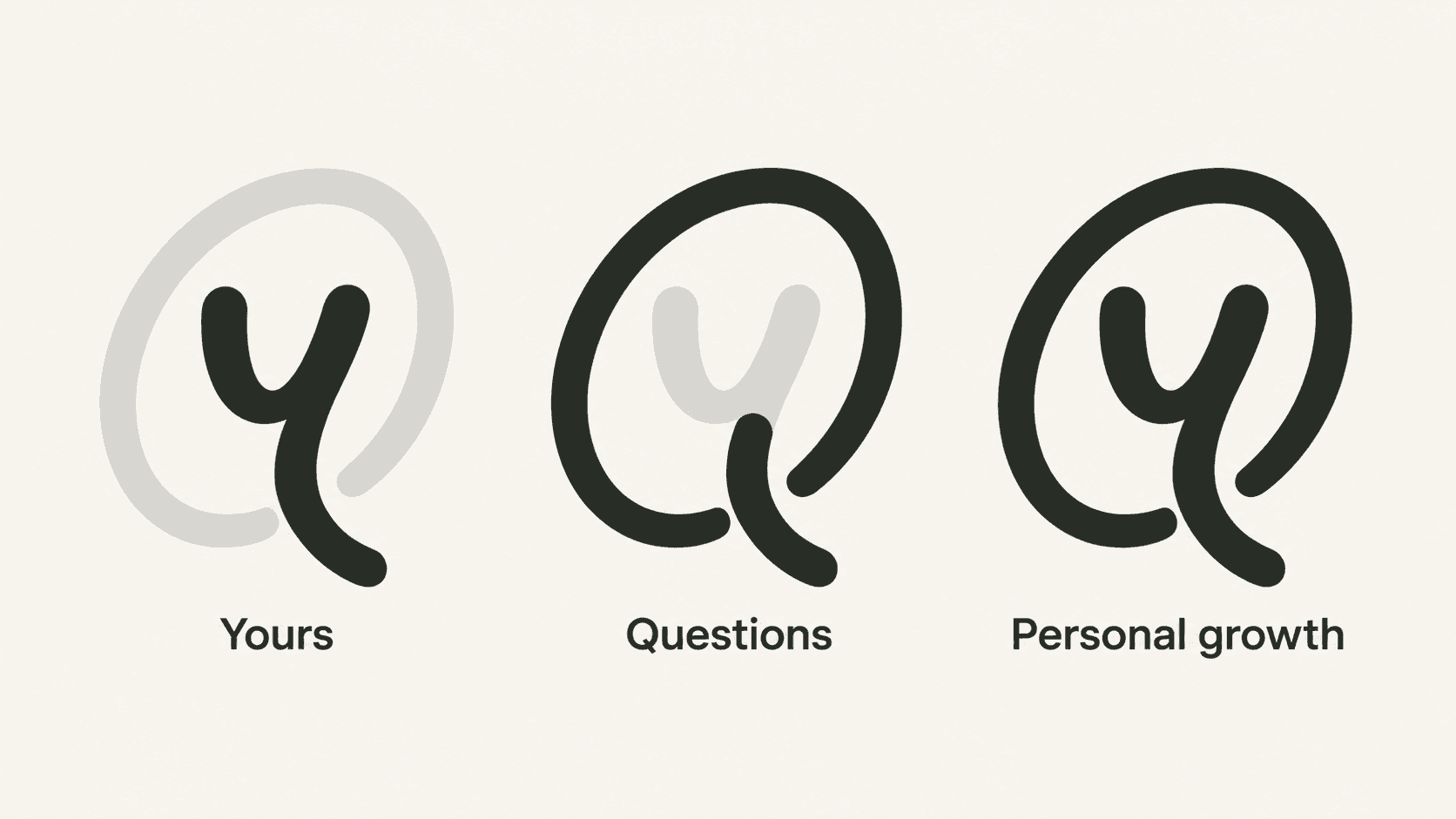
The Yours logo brings together three ideas: a journal that belongs to you, questions that help you reflect, and the growth you notice over time.
Look at the mark one way and you can see a Y. Follow the outer curve and the tail, and it becomes a Q. Take in the whole shape and there is a tree, with branches reaching into a rounded canopy. Each reading says something about the journal I want Yours to be.
Why I called it Yours
A journal can hold a shopping list next to a difficult thought. A photograph from a walk might sit beside three sentences about an otherwise ordinary Tuesday. Those things belong together because they belong to the same person. They do not need to make sense to anyone else.
I chose the name Yours to put that person at the centre. Your words, your memories, your way of making sense of a day. The app gives them a place to live, while you decide what is worth keeping.
That ownership is practical, too. Yours keeps entries as ordinary Markdown files and images in folders on your Mac. You can open those files, organise them, and use them with other tools. A journal may matter to you for much longer than any particular app does. Its contents should be yours to keep.
Y is for Yours
The branching stroke inside the logo forms a Y. It is the most direct connection to the name, and a reminder that the starting point is you.
There is no required kind of entry. Some days you might write a page. Other days, a sentence and a picture are enough. You can describe what happened, work through something unfinished, or save a small detail you would otherwise forget.
You also get to choose the pace. An entry after a quiet week belongs just as much as one written the next morning. I want the name to leave room for that: a journal you return to when you have something to put into words.
Q is for questions
The outer loop and descending tail suggest a Q. This is the questioning part of the mark: the moment when writing down an event turns into wondering about it.
“What stayed with me today?” is often an easier beginning than trying to describe the entire day. Once you have an answer, “Why did that matter?” gives you somewhere to go next.
Imagine writing, “I felt better after a short walk.” You could leave it there. Or you could ask what helped: being outside, moving around, or having ten minutes without a screen. The question makes space for a more useful observation.
That is what I mean by conversational journalling. One thought leads to a question, and the answer gives you another thought to explore. You can have that conversation on the page yourself. Built-in AI conversation is planned for a future release of Yours; it is not available yet. Journalling works without it.
A tree for personal growth
Seen together, the outer curve becomes a canopy and the Y becomes a branching trunk. The tree gives the logo its third meaning: personal growth.
I think of growth here as something you may notice when you look back. A worry that filled several pages might take up less space now. You might see that certain people or activities keep appearing in entries about good days. Or you might find that your answer to an old question has changed.
An individual entry does not have to contain a lesson. Recording the moment is enough. Over time, having those moments to return to can help you see connections that were difficult to spot while you were living them.
The tree is a reminder to give that process time. There is no streak to prove in this idea of growth, and no deadline for becoming a different person.
One mark, three connected ideas
The Y, the Q, and the tree share the same strokes because their meanings belong together. You keep something from your life. You ask a question about it. Later, you may see it a little differently.
That is the thought behind Yours: a place for your words, room for your questions, and a record you can return to as you grow.